
Waste Transfers
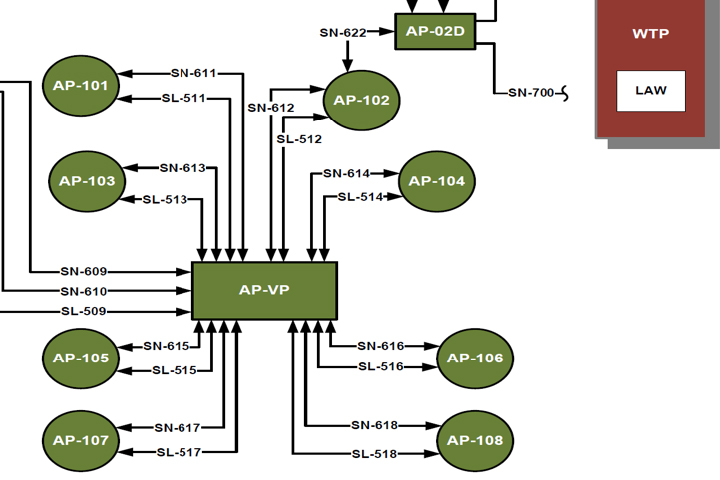
Double-shell tank (DST) waste transfer activities are comprised of DST to DST transfers, DST waste recirculations and decant waste transfers.
- DST to DST transfers pump the contents of one DST tank to another DST tank to make space or to stage waste in support of retrieval activities, 242-A Evaporator campaigns and waste feed delivery to the Waste Treatment Plant (WTP).
- DST waste recirculations are conducted to provide for a homogenous solution prior to performing grab samples for chemistry control evaluations, for 242-A Evaporator waste feed candidacy requirements, or to ensure tank chemistry controls are maintained within the Operating Specification Documents (OSDs).
- Decant waste transfer activities are needed to support the positioning of the DST system for waste feed delivery operations. Decants are performed to make space for receiving DSTs in support of waste retrieval activities.
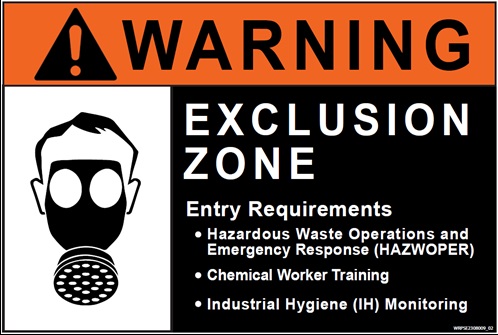
Exclusion Zones (EZs)
An administrative control boundary established around emission points (temporary or permanent) where Tank Vapors have the potential to exceed 50% of their OEL(s) (Tank Vapor COCs). The EZ boundary is to be identified using a physical barrier and signage, unless controlled as outlined in TFC-ESHQ-IH-C-48 Section 4.5 (e.g., by continuous monitoring). EZs can be inside or outside of a Tank Farm.
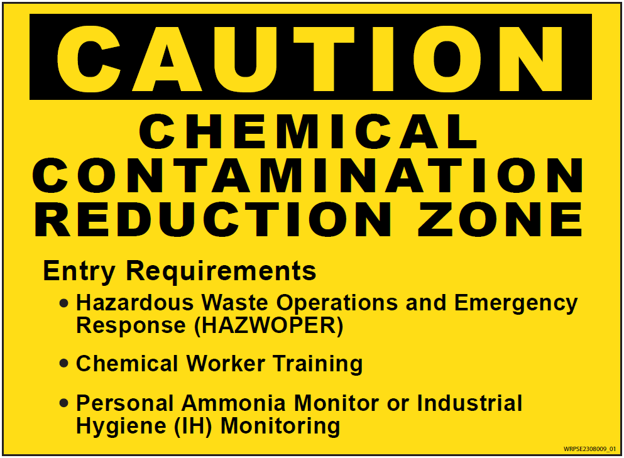
Chemical Contamination Reduction Zones (CRZs)
An administrative control boundary established around EZ(s). Chemical CRZs are areas where the potential for Tank Vapors exposure is less than 50% of the OEL(s). Additional training requirements are needed to access the area. Typically, this area will be designated as the Tank Farm fence line but may be larger or outside of a Tank Farm, as necessary.